This post may contain affiliate links. Please see my full disclosure for details.
Hi Bold Bakers!
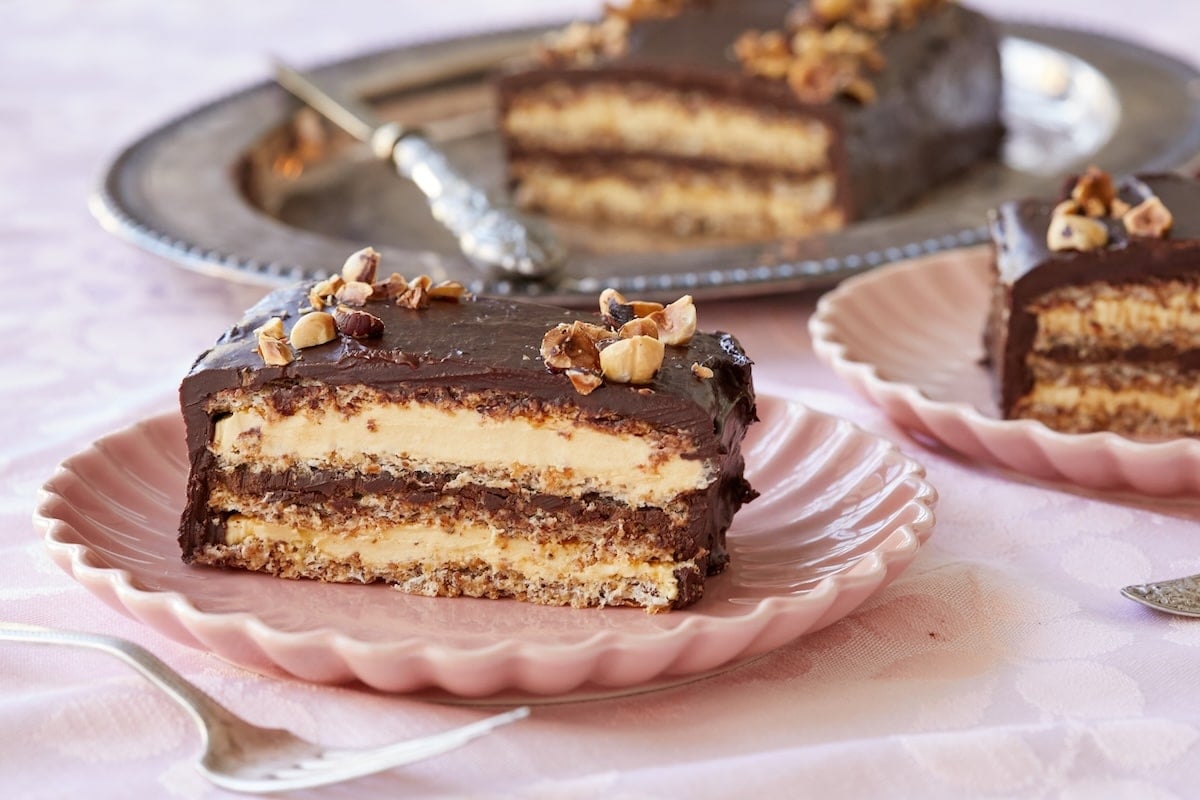
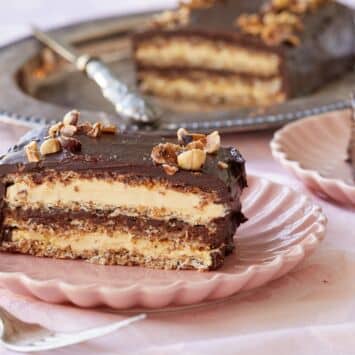
WHY YOU’LL LOVE THIS RECIPE: My dreamy Marjolaine is a stunning French bakery dessert made with crisp layers of nutty meringue, silky chocolate ganache, and luscious French buttercream. This elegant cake looks like it came from a fancy pâtisserie, but I’ll show you how surprisingly easy it is to make!
- Professional bakery results: This classic French pastry is impressive yet simple enough to make at home.
- Irresistible flavor combination: Hazelnut, chocolate, and honey create a rich, sophisticated flavor.
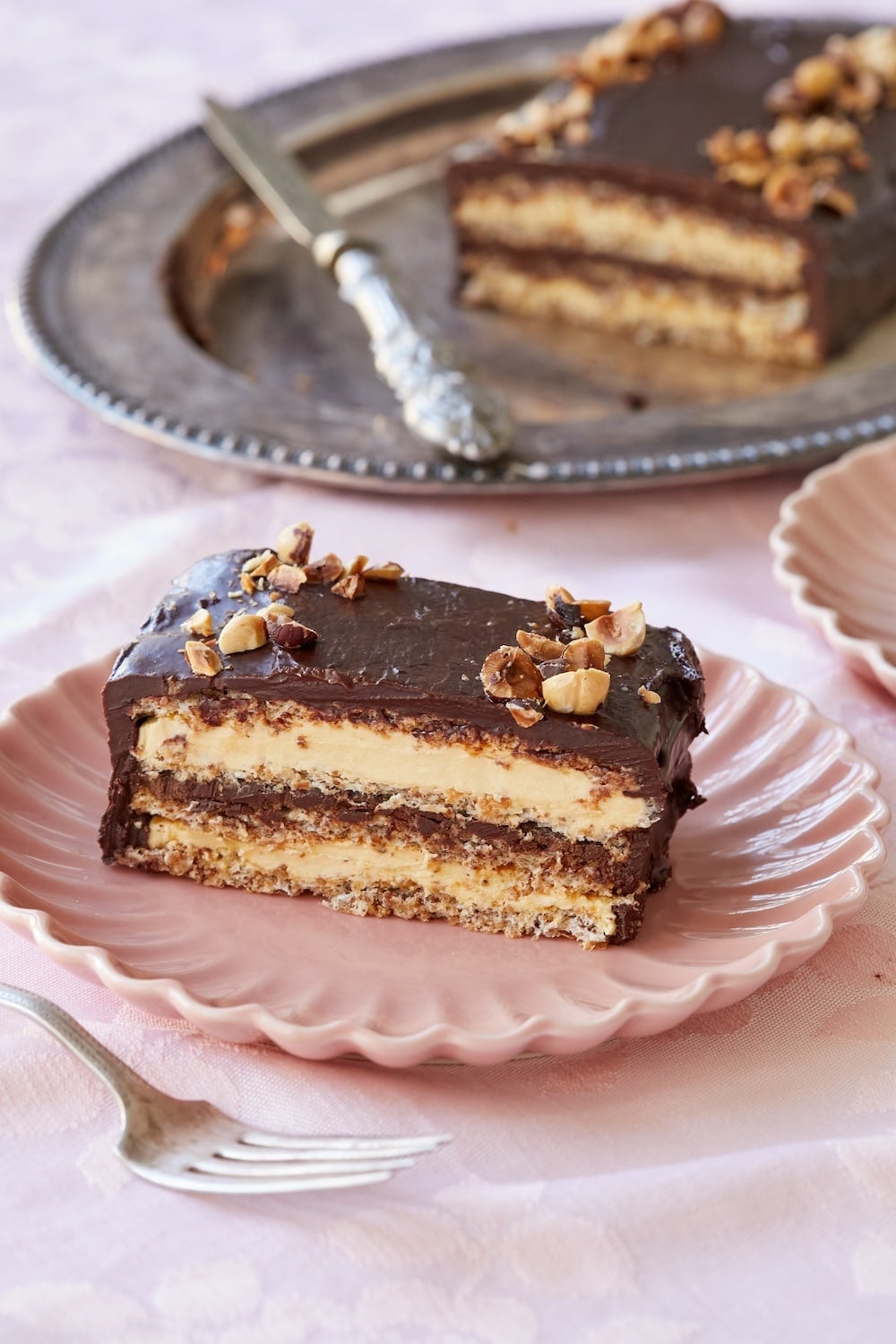
- Creamy and crisp in every bite: You’ll love the luscious layers of smooth buttercream, silky ganache, and airy meringue.
- Perfect for celebrations: Marjolaine turns birthdays, holidays, and dinner parties into unforgettable events.
- Beautiful presentation: With its dramatic layers and glossy ganache, this dessert always gets gasps when you bring it to the table.
After years of working as a professional chef, one of the most rewarding parts of starting Bigger Bolder Baking has been translating fine desserts into approachable step-by-step recipes that home bakers could truly master. Marjolaine may look complicated, but don’t let it intimidate you! Each part of the dessert is straightforward, and I’ll guide you through every step.
My top tip for you is to be gentle when folding the hazelnut mixture into the whipped egg whites so you don’t deflate the dacquoise. A light hand helps create beautifully light, crisp-chewy meringue layers, and using a thin-edged metal spoon will reduce the chance of knocking the air out of the mixture. For more special-occasion meringue desserts, you’ll love Meringue Nests with Strawberry and Coconut Cream, Raspberry Meringue with Pistachios, and Meringues with Peach and Raspberry Compote.
Table of Contents
- What is Marjolaine?
- Tools You Need
- Key Ingredients and Substitutes
- How to Make Marjolaine
- Gemma’s Pro Chef Tips
- Make-Ahead and Storage Instructions
- FAQs
- More Special Occasion Recipes
What is Marjolaine?
Marjolaine is an elegant French layered dessert made with crisp hazelnut dacquoise, silky French buttercream, and rich chocolate ganache, creating a treat that feels both luxurious and surprisingly airy. The cake was invented in the 1930s by renowned French chef Fernand Point at his legendary restaurant La Pyramide in Vienne, France, and is considered one of the great classics of French pâtisserie because of its beautiful contrast of crisp, creamy, and silky textures. Marjolaine evolved from the older French dacquoise—a nut meringue cake traditionally layered with cream or buttercream—which originated in the town of Dax in southwestern France centuries earlier.
Tools You Need
- Mixing bowls
- Measuring spoons
- Measuring cups
- Glass measuring jug
- Kitchen scale (optional)
- Heatproof bowl
- Small saucepan
- 10×15-inch (25x38cm) jelly roll pan
- Parchment paper
- Baking pan
- Tea towel
- Food processor
- Stand mixer (optional) or handheld electric mixer
- Thin metal-edged spoon or spatula
- Offset spatula (palette knife)
- Ruler
- Bench scraper
- Cooling rack
- Serrated knife
Key Ingredients and Substitutes
For the Ganache
Bittersweet chocolate
- Bittersweet chocolate gives the ganache deep flavor and balances the sweetness of the buttercream.
- Importantly, the bittersweet chocolate provides structure as the ganache sets.
- Substitutes: Use the same amount of dark chocolate or semi-sweet chocolate.
Heavy whipping cream
- Heavy whipping cream makes the ganache smooth, silky, and glossy.
- Be sure to use heavy whipping cream with a fat content of at least 36%.
- Using low-fat dairy could cause the ganache to split or be grainy.
For the Dacquoise (Hazelnut Cake)
Raw hazelnuts
- Hazelnuts give this dessert its signature nutty flavor and richness.
- Importantly, the hazelnuts also give the dacquoise structure and richness.
- Toasting is a must here because it brings out the flavor.
- Substitute: If you don’t have a food processor, you can use the same amount of store-bought hazelnut flour.
- You can also use the same amount of almonds in place of the hazelnuts.
Granulated sugar
- Granulated sugar adds sweetness.
- Importantly, sugar helps the whipped egg whites retain air and provide stability to the meringue.
- Additionally, sugar gives the meringue a crisp exterior texture
All-purpose flour
- All-purpose flour adds structure and stability.
- Importantly, the flour absorbs moisture, keeping the meringue dry enough to stay crisp.
- Substitute: Use an equal amount of a 1:1 gluten-free flour or use an equal amount of cornstarch.
Egg whites
- Egg whites give the dacquoise layers their signature lightness, airiness, and a crisp-chewy texture.
- Be sure to use room-temperature egg whites so they whip up well. Here’s how to safely warm eggs.
For the French Buttercream
Egg yolks
- Egg yolks contribute to a rich, velvety texture.
- Importantly, the yolks emulsify the ingredients into a uniform mixture.
- It’s important to use room-temperature egg yolks so they blend well.
Honey
- Honey gives the buttercream a deliciously deep, floral sweetness.
- Additionally, honey adds moisture.
- Substitute: Use an equal amount of maple syrup if you prefer.
Granulated sugar
- Granulated sugar contributes to the buttercream’s sweetness.
- Importantly, the granulated sugar helps create a stable, smooth mixture.
Butter
- Butter adds body and thickness.
- Additionally, butter gives the frosting a silky, smooth mouthfeel.
- Importantly, butter gives the frosting stability when it’s chilled.
How to Make Marjolaine
Ganache
- Add chocolate to bowl. Place the chocolate in a medium heatproof bowl.
- Heat cream and pour over chocolate. In a small saucepan, heat the cream until steaming (but not boiling). Pour the hot cream over the chocolate and let it sit for 10 minutes without stirring.
- Finish ganache. Once the chocolate has melted, gently stir the cream into the chocolate until smooth. Set aside at room temperature to thicken.
Dacquoise
- Prepare to bake. Preheat the oven to 350°F (180°C). Butter and line a 10×15-inch (25x38cm) jelly roll pan with parchment paper. Then butter and flour the parchment paper because this cake is sticky. Set aside. *See note below about pan sizes.
- Toast the nuts. Spread the hazelnuts on a separate baking sheet and toast until lightly browned, 10 to 15 minutes. Rub the toasted hazelnuts with a clean tea towel to remove any loose skin and set aside to cool.
- Lower temperature. Lower the oven temperature to 300°F (150°C) for the cake.
- Grind nuts. Place the hazelnuts in the bowl of a food processor along with 3 tablespoons of sugar and process until finely ground, about 20-30 seconds. Transfer to a small bowl and stir in the flour. Set aside.
- Whip egg whites. With a stand mixer fitted with a whisk attachment or with a handheld mixer, whip the egg whites to soft peaks.
- Add sugar. While constantly whisking the egg whites, add in the remaining ⅓ cup (2½ oz/71 g) sugar one spoon at a time and whip to stiff peaks.
- Add nut mixture. Gently fold in the hazelnut mixture and then spread evenly into your prepared jelly roll pan. Use a palette knife to make the batter as even as possible.
- Bake dacquoise. Bake for 20 to 25 minutes, until lightly golden.
- Cool. Place a piece of parchment on top and Invert the cake onto a wire rack to cool. Gently peel off the paper.
- Cut evenly. Starting at a long edge, use a ruler to measure and cut the cake into 4 equal-sized strips, each roughly 3 ½ x 10 inches (less than 10 x 15 cm). Set aside.
French Buttercream
- Add yolks to bowl. Place the egg yolks in the bowl of a stand mixer fitted with a whisk attachment or in a medium bowl with an electric mixer.
- Heat honey and sugar. Combine the honey and sugar in a small saucepan over medium heat until the honey is at a rolling boil and the sugar has dissolved.
- Cool honey mixture. Once the honey mixture is ready, remove from the heat and allow to cool for 5 minutes.
- Whisk yolks and add honey mixture. Start to whisk the eggs on high speed for 5 minutes, until thick. Slowly drizzle in the hot honey mixture, taking care to pour the mixture down the side of the bowl to avoid the whisk. (If the honey mixture cooled down too much, pop it back on the stove top to liquify.) Keep whisking the mixture for about 10 minutes, until the yolks have reached room temperature.
- Mix in butter. When the egg yolk mixture has completely cooled, begin to add the butter, 1 tablespoon at a time, until fully incorporated and you have a smooth buttercream. Set aside.
Assemble the Marjolaine
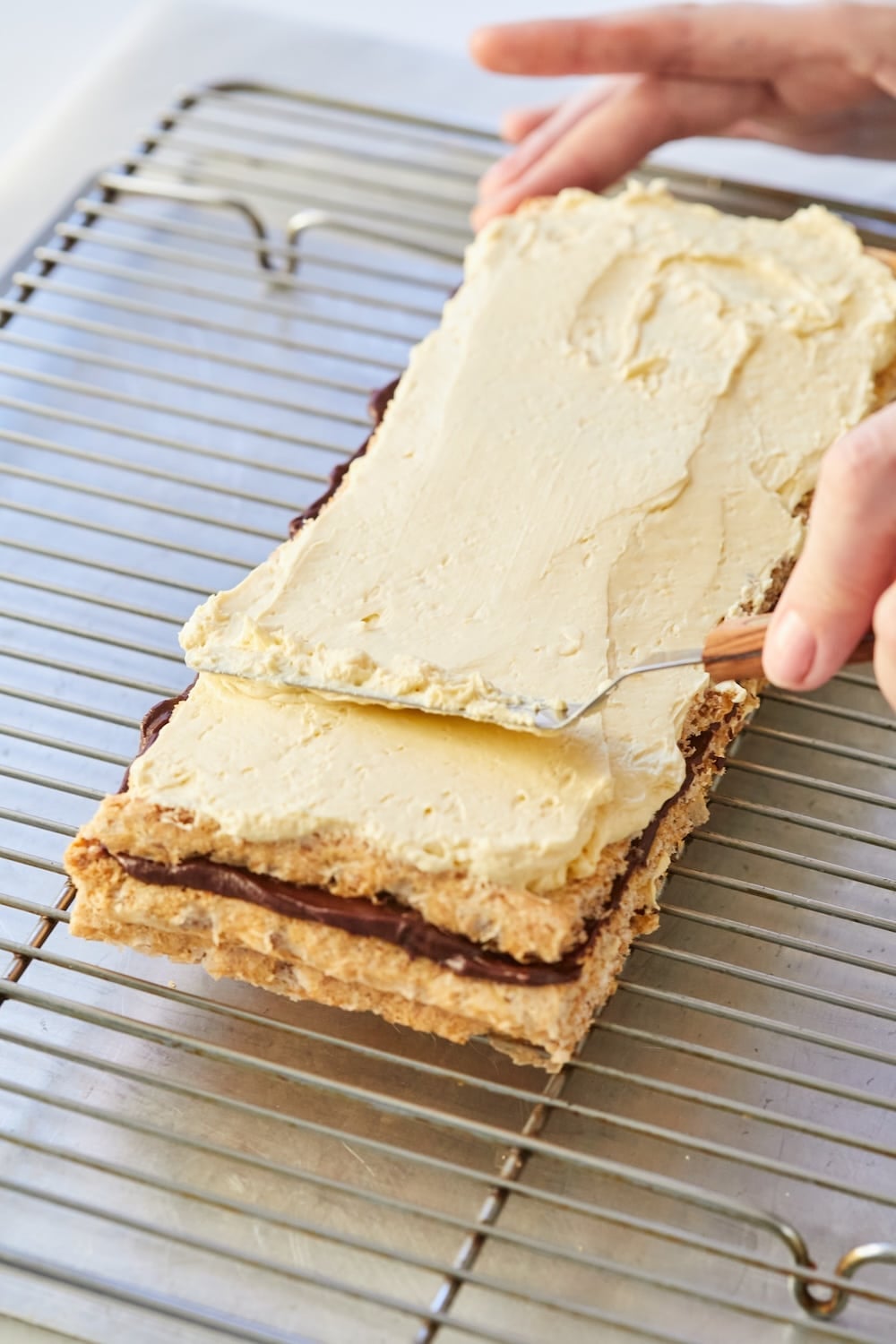
- Frost first layer. Place one layer of cake on a cooling rack over a baking pan. Spread with half of the French buttercream.
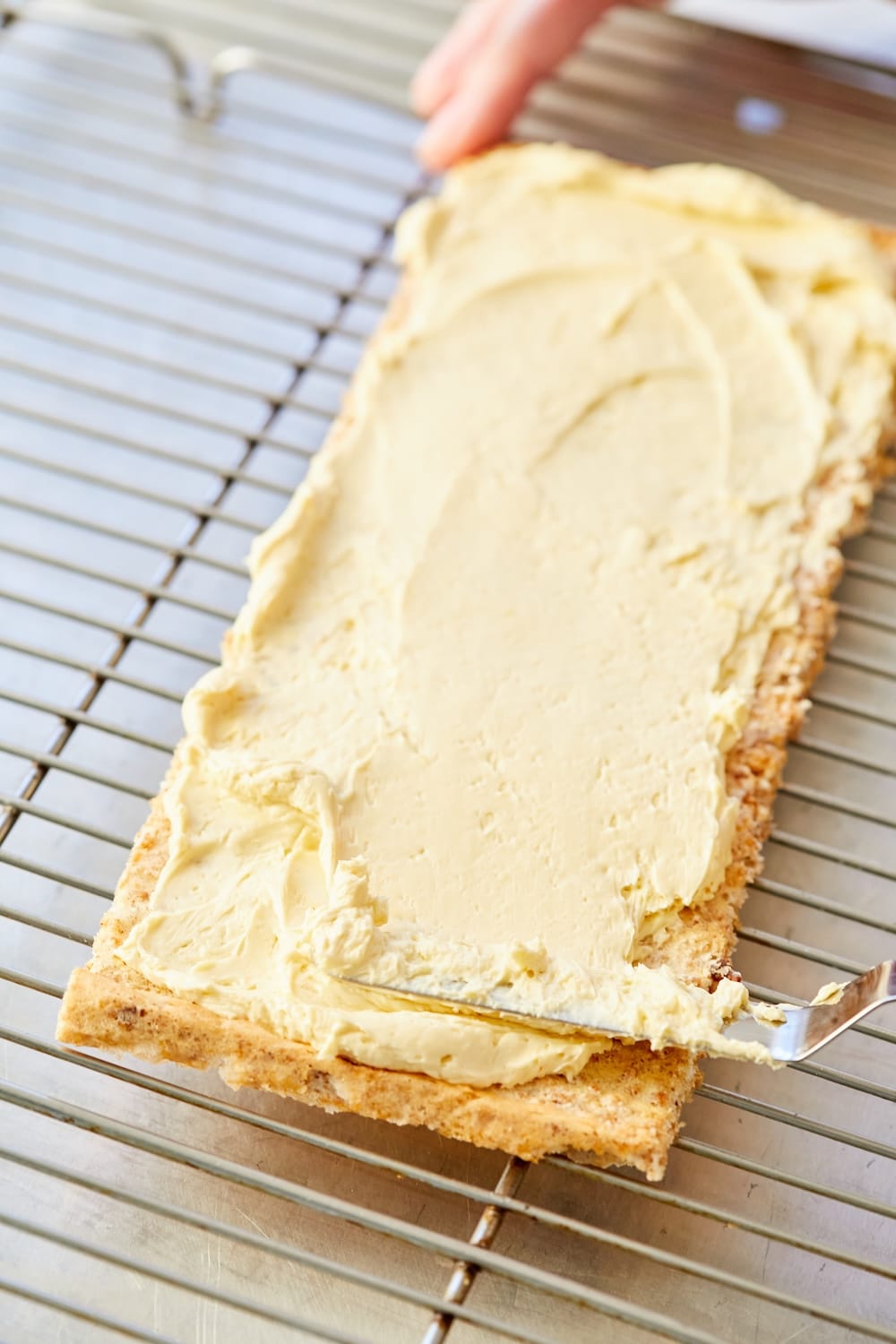
- Add second layer, frost, and add ganache. Place a second layer of cake on top of the buttercream and spread roughly ⅔ cup (5 oz/142 g) of the cooled ganache over this layer.
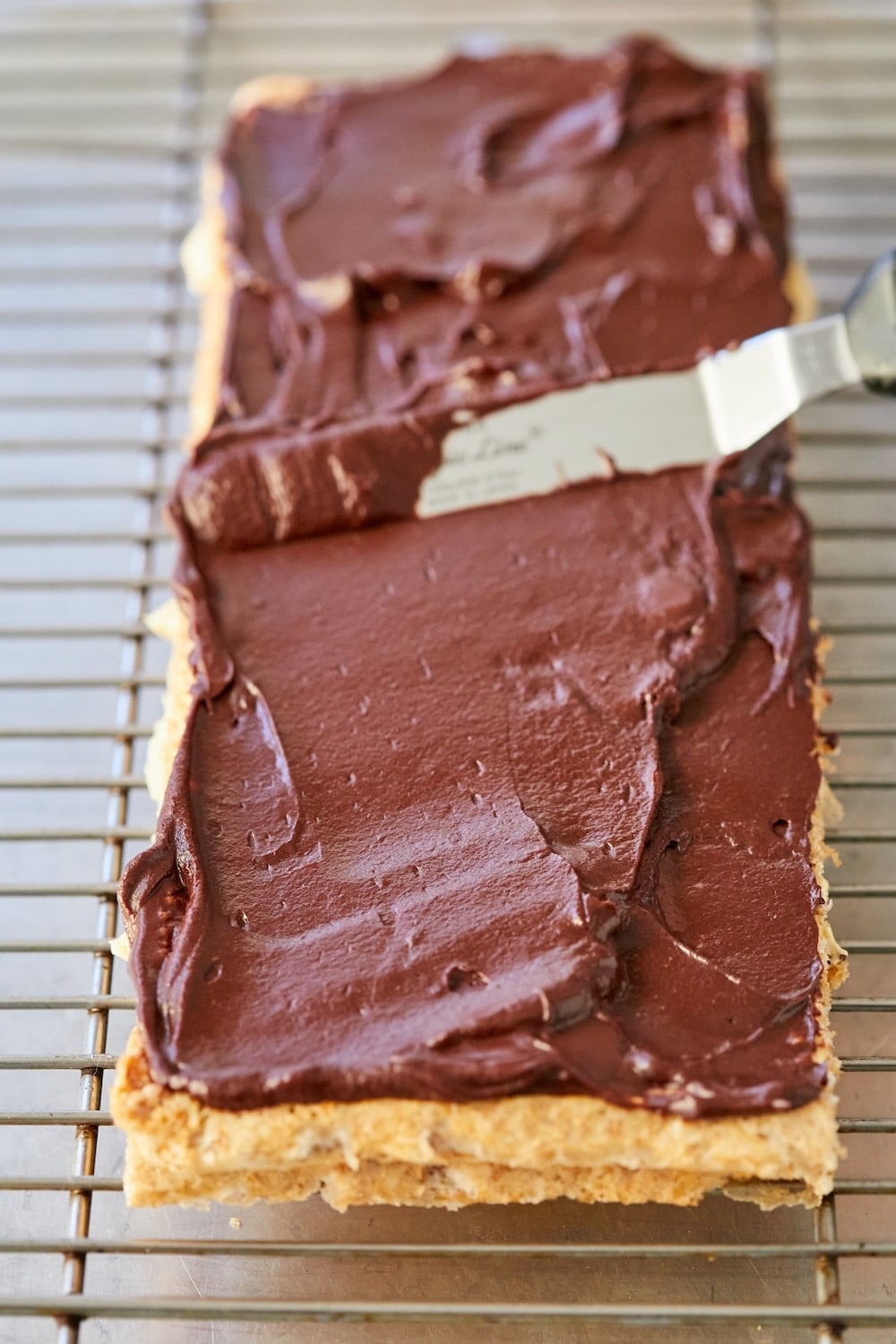
- Finish layering. Top with a third layer of cake and the remaining buttercream, followed by the final cake layer.
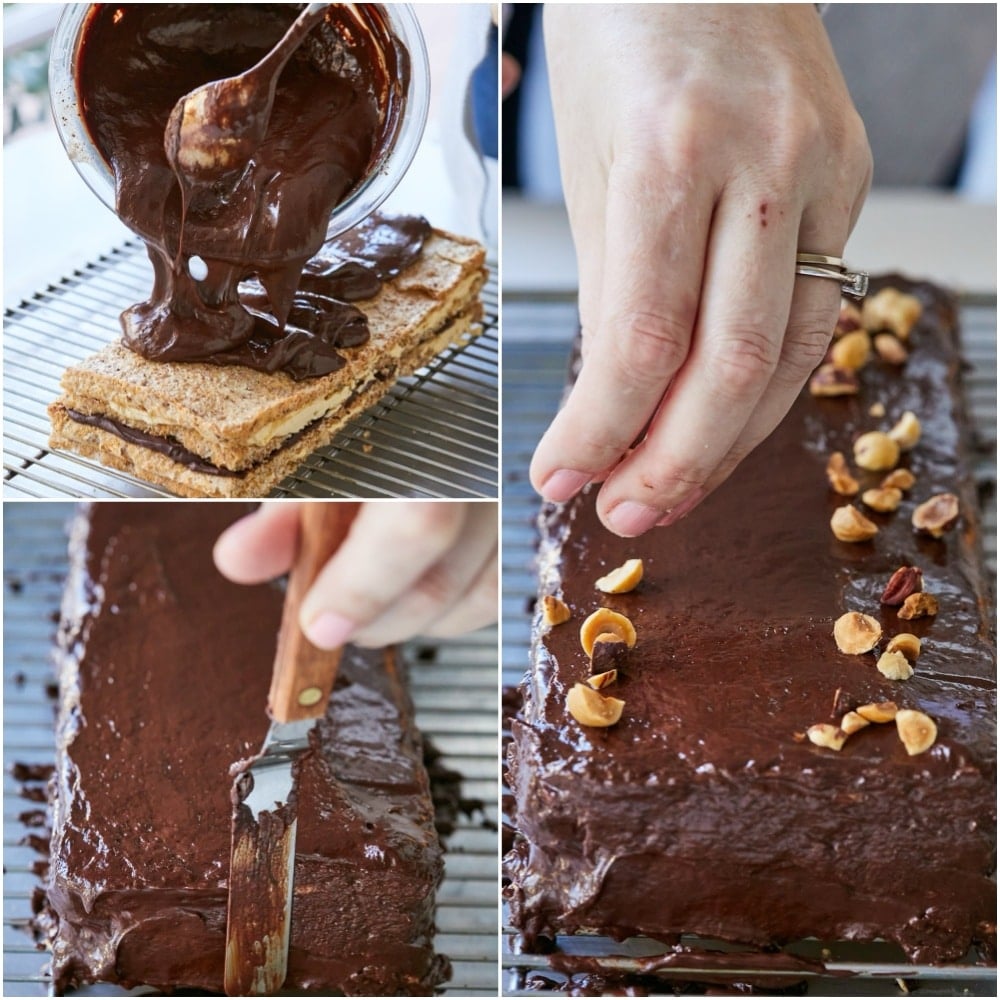
- Warm remaining ganache. Warm up the remaining ganache for a few seconds in the microwave or in a small saucepan over low heat until it reaches a pourable consistency.
- Finish and chill. Pour the ganache over the cake and smooth with a palette knife. Garnish with some extra toasted hazelnuts if desired. Place in the fridge to set for a minimum of 1 hour.
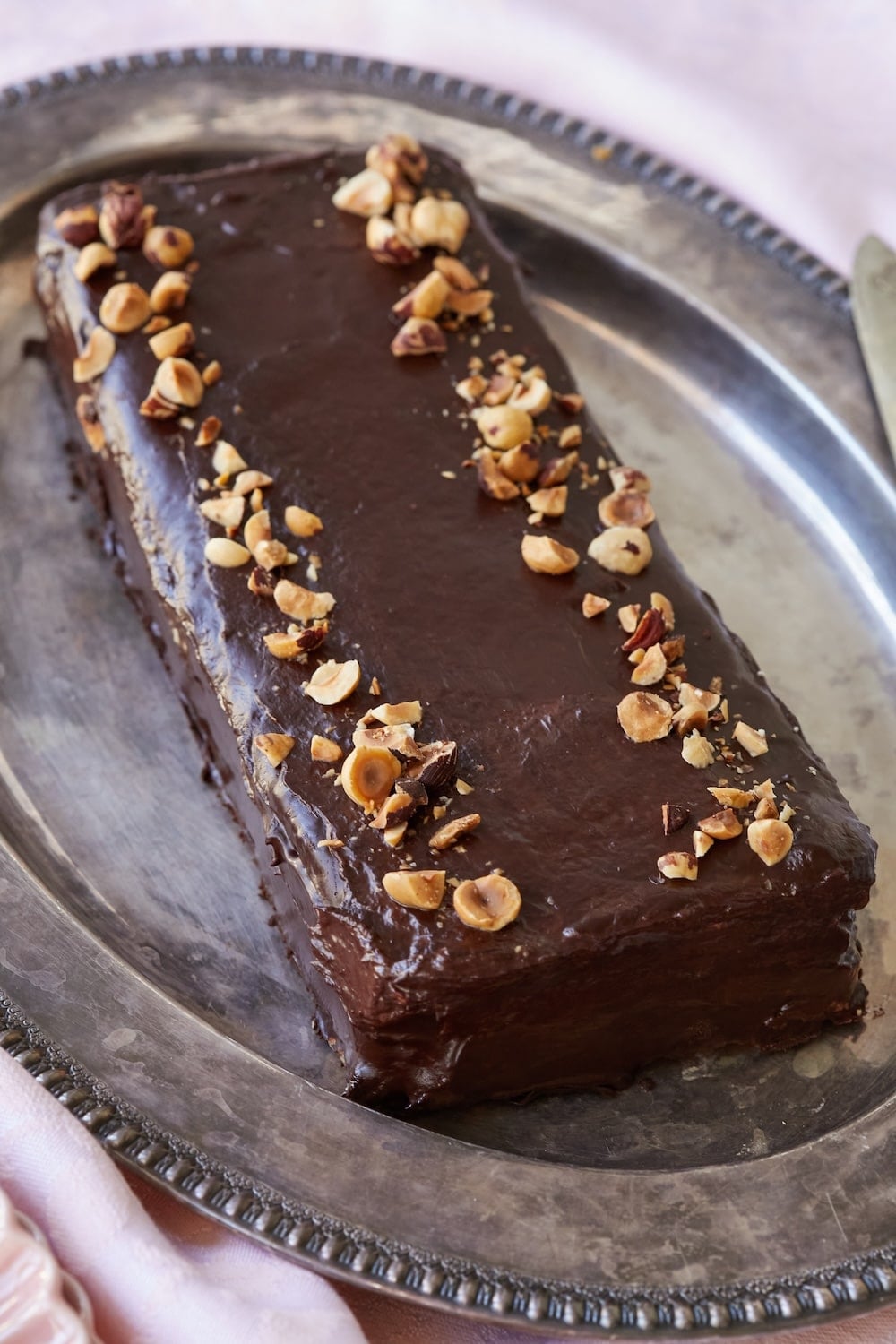
- Serve and enjoy. Gently lift the cake onto a serving plate. Serve straight away or keep refrigerated for up to 2 days.
FULL (PRINTABLE) RECIPE BELOW!
Gemma’s Pro Chef Tips
- Pan size options: You can use a 10×15-inches (25x38cm), 11×17-inches (28x43cm) or 13×18-inches (33x45cm) jelly roll pan. Just make sure to divide it evenly into 4 pieces for the cake.
- Use a different flavored buttercream. The buttercream can be flavored with 2 tablespoons of instant espresso powder dissolved in 1 teaspoon of hot water to make a coffee buttercream, or you can use a caramel buttercream (beat 1/2 cup of thick, room-temperature caramel sauce or dulce de leche until fully incorporated and silky) or an orange buttercream (add 2 teaspoons of finely grated orange zest to the buttercream and whip until smooth).
- Switch to pastry cream. For a softer, more custard-like filling, you can switch out one or both of the layers of buttercream with pastry cream.
- Swap Nutella for buttercream. For a more pronounced hazelnut flavor, you can replace the ganache filling (but not the outer coating) in this dacquoise cake with Nutella.
- Let the ganache sit before stirring. Giving the ganache mixture a full 10 minutes to sit before stirring ensures it’s fully emulsified and prevents graniness.
- Toast the hazelnuts well. This is important to bring out their flavor. Toast until lightly golden and fragrant.
- Be sure the yolk mixture is at room temperature before adding butter. If it’s not, the butter could melt when added. This will prevent the frosting from being light and silky.
- Chill between layers. If your kitchen is warm, you can chill the marjolain between layers as you assemble.
- Quick fix for sticking dacquoise: If your daquoise rectangles are sticking to the parchment paper, Invert the dacquoise onto a rack so that the parchment paper is facing up. Place a damp tea towel on top of the paper and let it rest like this for 5 minutes. The paper should now lift off easily.
- Chill before slicing. Refrigerating for at least an hour gives the ganache time to set and stabilizes the layers. Use a hot knife when cutting, and wipe it off between cuts.
Make-Ahead and Storage Instructions
Make-ahead tips
- This cake can and should be made up to 24 hours before you want to serve it so that the dacquoise has a chance to soften and the flavors develop.
- The ganache and buttercream can be made up to one week in advance, placed in airtight containers, and refrigerated.
- Bring the ganache and buttercream to room temperature on the counter for several hours before you begin to assemble the cake.
How to store leftovers
- Wrap leftover Marjolane well with plastic wrap and refrigerate for up to two days.
FAQs
Can I make Marjolaine gluten-free?
- Yes, you can make Marjolaine gluten-free.
- Simply replace the all-purpose flour with an equal amount of gluten-free flour or cornstarch.
How do I make a perfect buttercream for this recipe?
- The honey needs to reach a very high temperature before you add it to the yolk, or it won’t thicken the buttercream properly.
- Be sure your eggs are at room temperature before you add the butter. If they are too warm, the butter will melt, and this will adversely affect the buttercream’s texture.
- Use butter that is on the cooler side of room temperature to create the best texture.
- If it seems thin, then put the bowl of buttercream in the refrigerator for 20 minutes, and then whip again.
What do I do if my ganache breaks?
- You can fix a broken ganache by placing the ganache in a bowl over a pot of simmering water and blending it back together with an immersion blender.
- If this doesn’t bring it back together, try adding a splash of warm milk (not cream) into the ganache and continue blending with the immersion blender.
- To prevent it from happening, be sure your cream is steaming, not boiling. Also, let it sit for a full 10 minutes before stirring.
What do I do if my Marjolaine breaks while I’m cutting it?
- The beauty of frosted cakes–even the fanciest ones—is that you can always piece them together and cover them with ganache or frosting. Your Marjolaine will look fine and taste great!
More Special Occasion Recipes
- Tiramisu Cake
- Classic Opera Cake
- Chocolate Brownie Trifle
- 24-Layer Chocolate Cake
- Banofee Baked Alaska
Try These Recipes!
Marjolaine Recipe

Ingredients
For the Ganache
- 2 cups (12 oz/340 g) chopped bittersweet chocolate
- 1 ½ cups (12 fl oz/360 ml) heavy cream
For the Dacquoise (Hazelnut Cake)
- 1 cup (5 oz/142 g) raw hazelnuts
- 3 tablespoons plus ⅓ cup (2½ oz/71 g) granulated sugar
- 3 tablespoons all-purpose flour
- 6 large egg whites , at room temperature
For the French Buttercream
- 5 large egg yolks , at room temperature
- ½ cup (5 oz/142 g) honey
- ⅓ cup (2½ oz/71 g) granulated sugar
- 1 cup plus 2 tablespoons (9 oz/253 g) butter , softened
Instructions
To Make the Ganache
- Place the chocolate in a medium heatproof bowl.
- In a small saucepan, heat the cream until steaming (but not boiling). Pour the hot cream over the chocolate and let it sit for 10 minutes without stirring.
- Once the chocolate has melted, gently stir the cream and chocolate together until you have a smooth ganache. Set aside at room temperature to thicken.
To Make the Dacquoise
- Preheat the oven to 350°F (180°C). Butter and line a 10x15-inch (25x38cm) jelly roll pan with parchment paper. Then butter and flour the parchment paper because this cake is sticky. Set aside. *See note below about pan sizes.
- Spread the hazelnuts on a separate baking pan and toast until lightly browned, 10 to 15 minutes. Rub the toasted hazelnuts with a clean tea towel to remove any loose skin and set aside to cool.
- Lower the oven temperature to 300°F (150°C) for the cake.
- Place the hazelnuts in the bowl of a food processor along with 3 tablespoons of sugar and process until finely ground, about 20-30 seconds. Transfer to a small bowl and stir in the flour. Set aside.
- With a stand mixer fitted with a whisk attachment or with a handheld mixer, whip the egg whites to soft peaks.
- While constantly whisking the egg whites, add in the remaining ⅓ cup (2½ oz/71 g) sugar one spoon at a time and whip to stiff peaks.
- Gently fold in the hazelnut mixture and then spread evenly into your prepared jelly roll pan. Use a palette knife to make the batter as even as possible.
- Bake for 20 to 25 minutes, until lightly golden.
- Place a piece of parchment on top and Invert the cake onto a wire rack to cool. Gently peel off the paper.
- Starting at a long edge, use a ruler to measure out and cut the cake into 4 equally sized strips that will be roughly 3 ½ x10-inches (less than 10x15cm). Set aside.
To Make The French Buttercream
- Place the egg yolks in the bowl of a stand mixer fitted with a whisk attachment or in a medium bowl with an electric mixer.
- Combine the honey and sugar in a small saucepan over Medium heat until the honey is at a rolling boil and the sugar has dissolved.
- Once the honey mixture is ready, remove from the heat and allow to cool for 5 minutes.
- Start to whisk the eggs on high speed for 5 minutes, until thick. Slowly drizzle in the hot honey mixture, taking care to pour the mixture down the side of the bowl to avoid the whisk. (If the honey mixture cooled down too much, pop it back on the stove top to liquify). Keep whisking the mixture for about 10 minutes, until the yolks have reached room temperature.
- When the egg yolk mixture has completely cooled, begin to add the butter, 1 tablespoon at a time, until fully incorporated and you have a smooth buttercream. Set aside.
To Assemble The Marjolaine
- Place one layer of cake on a cooling rack over a baking pan. Spread with half of the French buttercream.
- Place a second layer of cake on top of the buttercream and spread roughly ⅔ cup (5 oz/142 g) of the cooled ganache over this layer.
- Top with a third layer of cake and the remaining buttercream followed by the final layer of cake.
- Warm up the remaining ganache for a few seconds in the microwave or in a small saucepan over low heat until it reaches a pourable consistency.
- Pour the ganache over the cake and smooth with a palette knife. Garnish with some extra toasted hazelnuts if desired. Place in the fridge to set for a minimum of 1 hour.
- Gently lift the cake onto a serving plate. Serve straight away or keep refrigerated for up to 2 days.







It’s fun to make and delicious to eat